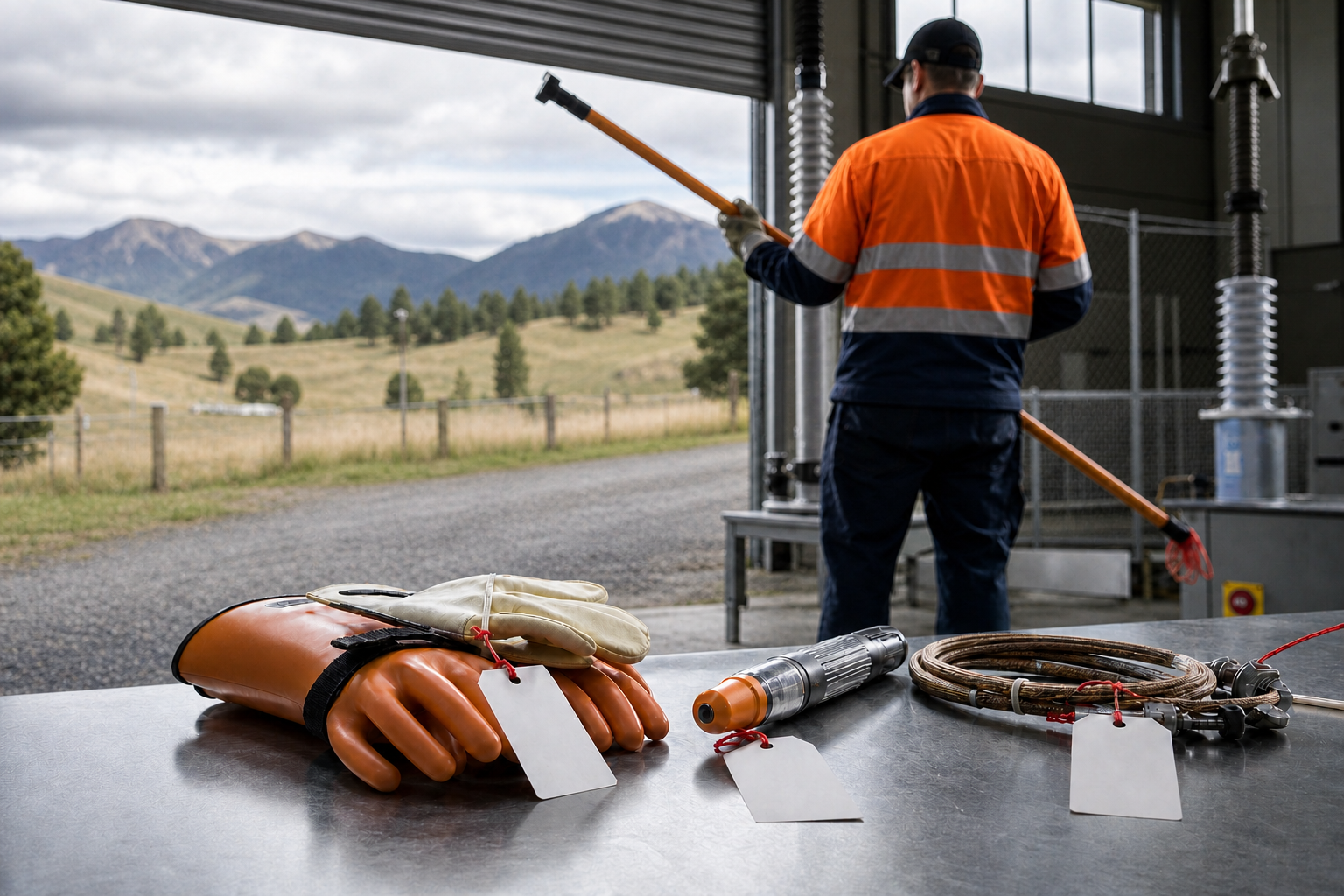
Every lines crew carries gloves, voltage detectors, operating sticks and portable earths. Each has its own test cycle, and when one lapses the item is out of service, usually at the worst moment. Here is a plain summary of the intervals in the Electricity Engineers' Association (EEA) Technical Guide: Portable Equipment for Work On or Near Conductors (April 2024).
What the guide is
The EEA describes the guide as an industry procedure under the Safety Manual: Electricity Industry (SM-EI). It is one recommended way to meet SM-EI requirements and does not replace them. It does not cover live-line tools or equipment used for live work under ECP 46.
The intervals
- Insulating gloves and sleeves: tested every six months to ASTM F496 or equivalent (section 4.5).
- Voltage detectors: checked before and after each use (5.4), tested against a voltage source at rated voltage every six months (5.5.1), with electrical tests every two years and results recorded (5.5.2).
- Operating and measuring sticks: six-monthly inspection and surface leakage test (8.5.1), and a two-yearly power-frequency withstand test (8.5.2).
- Portable earths: six-monthly inspection by a competent person (6.5.1) and a conductivity test every three years (6.5.2).
- EEA, Technical Guide: Portable Equipment for Work On or Near Conductors, April 2024 (publication page)
- EEA, same guide, PDF as hosted by StayLive (sections 4.5, 5.4, 5.5, 6.5, 8.5 cited)
What this means for you
The guide says each item should be marked with its next test due date or a register number, and that the due date must be checked before use. If your tags and register agree, you are in good shape. For gear used often or in wet conditions, section 8.5.1 says to test more often than six-monthly. Your own company procedures and the SM-EI still apply on top of the guide.
Want the whole kit tested on one visit? Email admin@deg.nz and we will come to you. We certify the equipment lives depend on.
Sources