Phased array ultrasonic testing (PAUT) has become the standard method on many inspection programmes — but it is not always the right choice, and it is not a guaranteed upgrade over conventional UT in every situation. Here is a clear-eyed look at what PAUT adds, what it costs, and when conventional UT is still the better call.
How Conventional UT Works
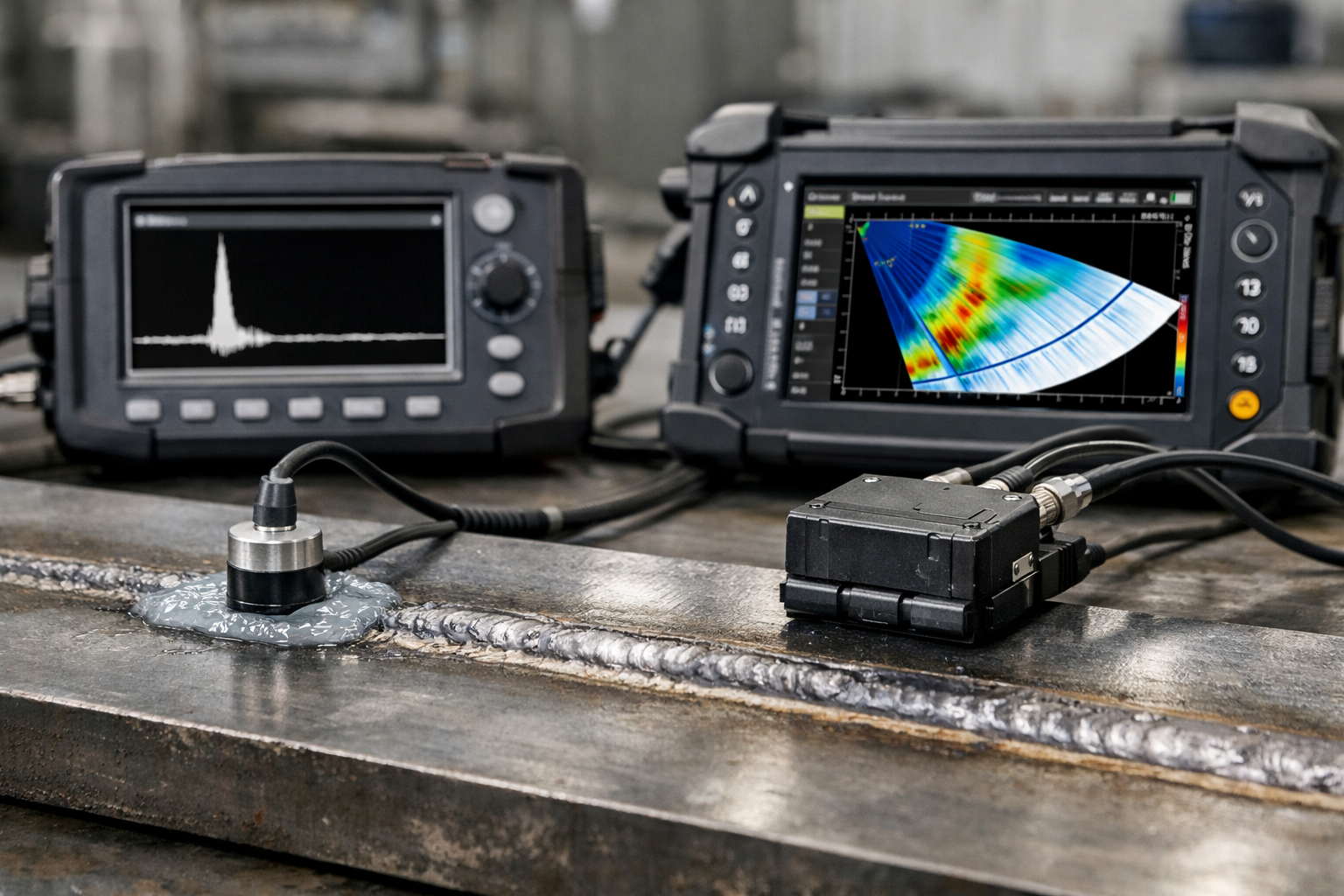
Conventional UT uses a single-element transducer that sends a sound beam into the material at a fixed angle. The inspector moves the probe manually across the inspection area, reading the A-scan display for indications of defects or back-wall echo loss. An experienced UT operator builds up a picture of the inspection zone through a series of overlapping scans. The results are recorded as written observations, measurements, and — where required — photographs of the display.
Conventional UT is well understood, widely specified, and appropriate for a large proportion of inspection work. It requires a competent operator and the right probe selection for the application, but it does not require expensive equipment or complex data interpretation.
How PAUT Works
PAUT uses an array of ultrasonic elements — typically 16 to 128 — that can be individually pulsed in sequence to steer and focus the sound beam electronically. Instead of a single fixed beam, the inspector can sweep through a range of angles in a single pass, producing a cross-sectional image — a sectorial scan or S-scan — that shows the internal structure of the weld or component in real time.
The image is stored electronically and can be replayed, zoomed, and analysed post-inspection. This produces a visual record of the inspection that is far easier to present to a client, auditor, or insurer than a written A-scan log.
What PAUT Adds Over Conventional UT
Better coverage per scan. A single PAUT probe sweeping multiple angles covers the same volume that would require several probe changes in conventional UT — reducing inspection time on thick-section welds significantly.
Improved defect characterisation. Because PAUT produces an image of the defect in cross-section, sizing and positioning is more accurate — particularly for planar defects like lack of fusion or cold cracks where the orientation relative to the beam matters.
A visual record. The S-scan image is a document. It can be stored, compared against previous inspections, and presented as evidence. In an ISO/IEC 17020 accredited inspection framework, this is increasingly expected on critical welds.
Faster scanning on complex geometries. Nozzle welds, pipe-to-pipe intersections, and variable-thickness sections that are difficult to scan with conventional UT can be covered more reliably with PAUT.
When Conventional UT Is Still the Right Call
PAUT is not always necessary. For straightforward fillet welds, thin-plate inspection, or situations where a qualified UT operator with a standard probe set can demonstrate full coverage, conventional UT is faster to set up, simpler to interpret, and perfectly adequate. Over-specifying PAUT adds cost without adding value.
The decision should be driven by the defect type, the weld geometry, the thickness, the applicable standard, and whether the client or insurer requires a visual record. If your ITP calls for PAUT on a simple butt weld in 8mm plate, ask why.
Level 3 Oversight
One aspect of PAUT that is sometimes overlooked: the technique must be developed and qualified by a Level 3 certified NDT practitioner before it is used in production inspection. A Level 2 operator can perform the scan, but the procedure behind it — beam coverage modelling, sensitivity calibration, acceptance criteria — must be signed off by a Level 3. DEG Survey & Inspection has Level 3 personnel across UT and PAUT who develop, qualify, and audit our own procedures in-house.
Get in touch: admin@deg.nz