
#wedoallthingssafely
#wedothingsright
Why Visual Checks on Insulating Gloves Aren't Enough

DEG
If your team works on or near live electrical equipment, insulating gloves are the last line of defence between a worker and a fatal shock. A visual inspection before use is essential — but it is not sufficient on its own. Here is what Class 0–4 actually means, what air inflation testing and dielectric testing involve, and what standard your insurer and WorkSafe expect to see on the certificate.
The Classification System — Class 0 to 4
Insulating gloves are classified by the maximum use voltage they are rated for:
- Class 00: Up to 500V AC / 750V DC
- Class 0: Up to 1,000V AC / 1,500V DC
- Class 1: Up to 7,500V AC / 11,250V DC
- Class 2: Up to 17,000V AC / 25,500V DC
- Class 3: Up to 26,500V AC / 39,750V DC
- Class 4: Up to 36,000V AC / 54,000V DC
Each class is manufactured to a different rubber compound specification and tested to a different proof voltage. Using a Class 0 glove on a 11kV system is not just non-compliant — it is a life-safety failure waiting to happen.
Why Visual Checks Are Not Enough
Rubber degrades. UV exposure, ozone, oils, chemicals, and mechanical stress all attack the insulating properties of rubber gloves over time — and the degradation is often invisible. A glove that looks perfect on the outside can have micro-cracks, pinholes, or ozone cracking in the rubber matrix that dramatically reduce its dielectric strength. Visual inspection catches gross damage — cuts, tears, obvious cracks — but it cannot detect the subtle internal degradation that makes a glove dangerous.
Air Inflation Testing
Air inflation testing is the first step in a full glove inspection. The glove is inflated — either by rolling the cuff or using a mechanical inflator — to approximately 1.5 times its volume, and held for at least one minute. Any loss of pressure, visible expansion unevenness, or audible hissing indicates a leak and the glove is failed. This is a fast, practical test that catches pinholes and seam failures that visual inspection misses.
Dielectric Testing
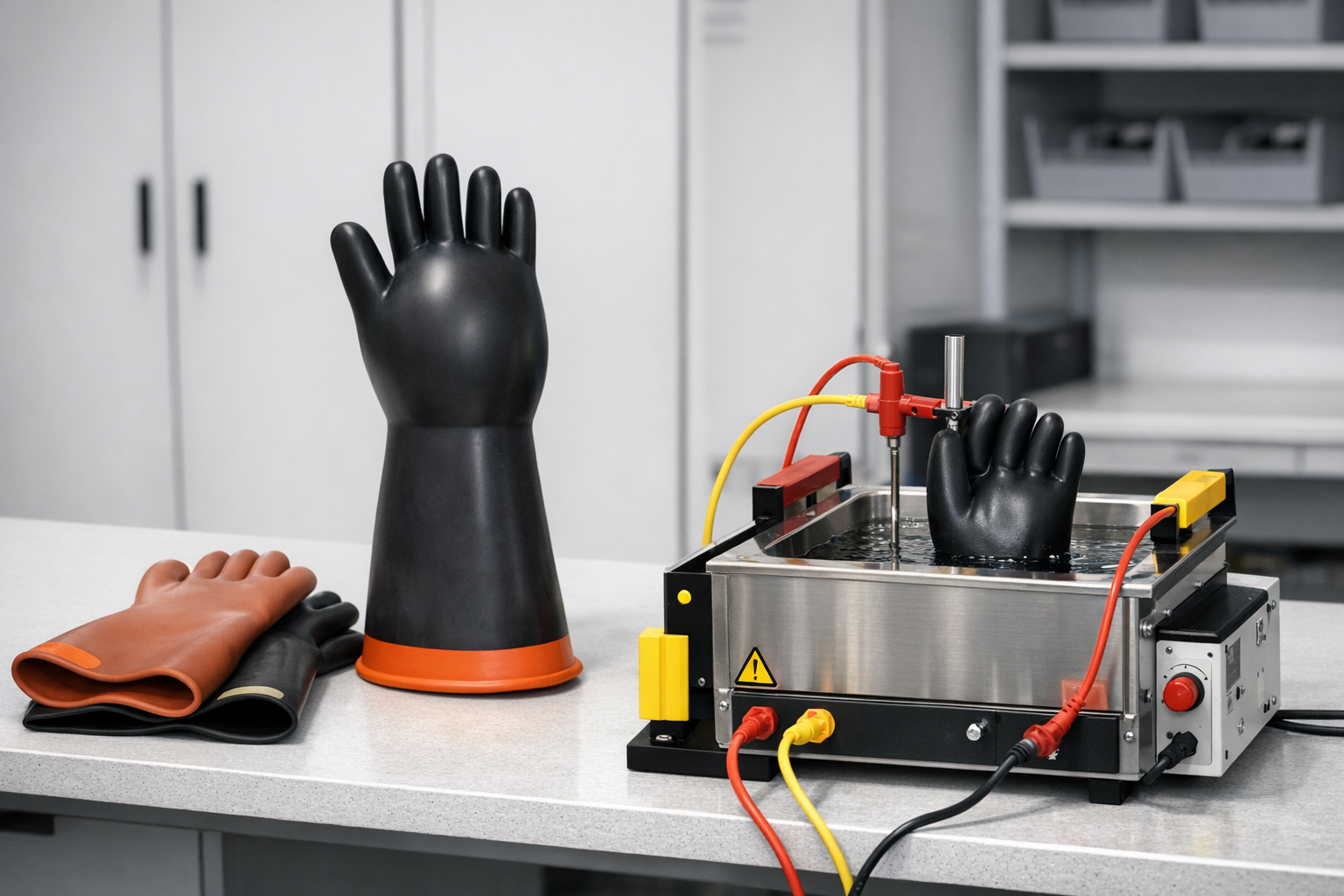
Dielectric testing is the definitive test of a glove's insulating integrity. The glove is filled with water and immersed in a water bath, with electrodes in both the water inside the glove and the water outside. A proof voltage is applied — the specific voltage depends on the class — and the leakage current is measured. If the leakage current exceeds the limit for that class, the glove fails.
This is the test that tells you whether the rubber is still doing its job electrically. It cannot be replicated visually or by feel. It requires a calibrated high voltage test set and a trained operator.
The Standard Your Insurer Expects
Gloves must be tested in accordance with AS/NZS 2225 (insulating gloves for electrical purposes) and retested at intervals not exceeding 6 months for gloves in active use. The test certificate must reference the standard, the class, the proof voltage applied, the leakage current measured, and the date of the next test due.
A test certificate from a non-accredited provider — one that is not an IANZ ISO/IEC 17025 accredited laboratory — may not be accepted by your insurer or by WorkSafe in the event of an incident. The accreditation behind the certificate is what makes it defensible.
DEG Calibration & Compliance is an ISO/IEC 17025 IANZ-accredited laboratory for insulating glove and sleeve testing. We test Class 0–4, issue certificates that reference the standard and the accredited scope, and manage retest reminders through our compliance platform so gloves don't fall through the cracks between inspection cycles.
Get in touch: admin@deg.nz